
“Retirement Is Not the End?”
Are Reappointments Blocking the Path of Deserving Officers?
Staff Reporter, Duranta TV, Agartala
The biggest discussion inside the state administrative circles right now is the continuous reappointment of retired officers. The question being raised is — are these reappointments really necessary for administration, or are they being used to benefit a selected group by blocking the promotion of deserving serving officers?
According to administrative sources, repeated reappointment of retired officers to important posts has created strong dissatisfaction inside the Secretariat. Because of these reappointments, many senior serving officers are reportedly being deprived of their rightful promotions. At the same time, opportunities for fresh recruitment are also shrinking, directly affecting thousands of educated unemployed youths.

Legal experts say that reappointment is not considered a “normal administrative process.” Under Fundamental Rule 56, government employees have a fixed retirement age. Reappointment after retirement should only happen in exceptional and special circumstances. But when the same individuals continue receiving repeated extensions, questions naturally arise — does the state really have a shortage of qualified officers?
Article 14 and Article 16 of the Indian Constitution guarantee equality and equal opportunity in public employment. Therefore, if deserving serving officers are ignored and certain individuals are repeatedly brought back into office, such actions can be challenged in court as “arbitrary administrative action.”

Anindya Kumar Bhattacharya’s retirement announcement in 2022
At present, the names most discussed in administrative circles are Anindya Kumar Bhattacharya, Subhendu Dasgupta, and Arun Kumar Roy. It is being alleged that even 11 years after retirement, Subhendu Dasgupta continues to remain active in the Secretariat through repeated extensions. Similarly, allegations claim that retired officers are continuing in important administrative positions through one extension after another. A section of officers believe these continuous reappointments are blocking the promotions of many deserving officials.
Legal experts further point out that even after an extension order is issued, it does not become a permanent or absolute right. Since most reappointments and extensions are contractual in nature, the government has the authority to cancel them on grounds such as “public interest,” “administrative review,” “policy decision,” or “irregularities in the appointment process.”
This means that if the government believes:
- there was no transparency in the reappointment,
- deserving serving officers are being deprived,
- administrative balance is being disturbed,
- or recruitment norms were violated,
then the extension can still be cancelled even while it is active.


Anindya Kumar Bhattacharya’s first and second appointment letter after retirement
Administrative experts say the government can form a Review Committee to examine all such reappointments. It can also review whether Finance concurrence, Cabinet approval, DoPT guidelines, and recruitment norms were properly followed.
Not only administratively, such reappointments can also be challenged through a Public Interest Litigation (PIL) in the High Court. Because when reappointments block promotions of serving officers and reduce fresh recruitment opportunities, the issue becomes a matter of larger public interest.
A section of the administration believes that instead of repeatedly rehabilitating retired officers, the government should focus on:
- promoting deserving senior serving officers,
- filling vacant posts through fresh recruitment,
- and creating opportunities for younger officers in administration.
Because in a healthy administration, “extension culture” should not become the norm. Transparency, merit, and institutional continuity should remain the foundation.


Anindya Kumar Bhattacharya’s third and fourth reappointment after retirement
Now the question being raised is — does the state really lack qualified officers? Thousands of educated unemployed youths are struggling for jobs, while the same individuals are allegedly being repeatedly reappointed, turning administration into what critics call a “private club of interests.”
At the center of this controversy is the name of Anindya Kumar Bhattacharya. Allegations claim that after retirement, he has continued in an important Secretariat position through six consecutive six-month extensions. Though few are speaking openly, sources claim that many officers are deeply unhappy with these repeated extensions. Multiple government notifications — from his retirement to the latest extension order — are now circulating in administrative circles.


Anindya Kumar Bhattacharya’s fifth and sixth reappointment letters after three years of retirement
Apart from Anindya Kumar Bhattacharya, several other names are also reportedly linked with reappointments inside the Secretariat. These include Subhendu Dasgupta, Deepak Dasgupta of GA(P&T), Additional Secretary Arun Kumar Roy, Asim Saha, Director of Employment and Manpower, and Ranjit Das, Joint Commissioner at Tripura Bhavan, Delhi.
Another discussion is also gaining momentum within administrative circles — claims are being made that Anindya Kumar Bhattacharya is allegedly “dependent” on Devyani Madam in several official matters, and that important hearings and processes are being handled with her involvement. This has also led to questions being raised about why Tripura’s Vigilance Department appears to be in “deep sleep.”
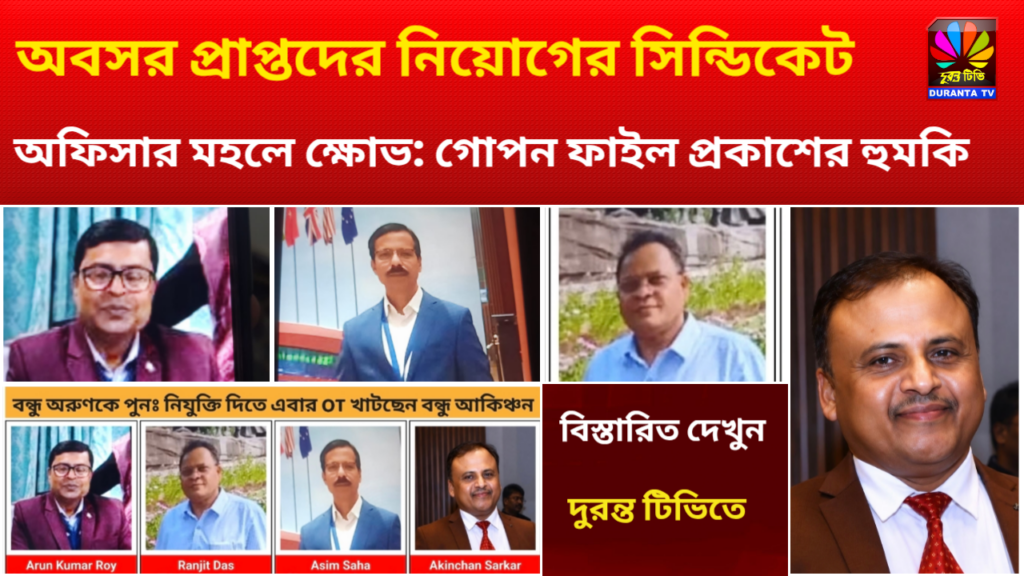
However, these allegations have not yet been independently or officially verified. DURANTA TV has also not independently verified these claims.
Inside the administration, another phrase is now frequently being heard — “the ghost is inside the mustard itself.” In other words, if the very system responsible for oversight becomes questionable, then how can neutrality truly be ensured?
In this backdrop, another sensitive question is now emerging — is there an invisible network of financial interests or institutional benefits behind these repeated reappointments? A screenshot allegedly shared by a former senior TCS officer is said to indicate such possibilities, and discussions around it are growing within administrative circles. However, these claims too remain unverified publicly.
Still, the repeated appearance of the same names and the continuous extension culture are making these questions even stronger.
So the biggest question now is — are these reappointments genuinely necessary for administration, or are they part of an invisible culture of privilege operating inside the corridors of power?
And in search of that answer, even more explosive information is expected to emerge.
Now all eyes are on whether the government will step forward to end this controversial culture of reappointments and restore balance within administration — or whether the same cycle will continue.
Coming next — “The Ghost Inside the Mustard,” where the hidden network and invisible equations behind the system will be revealed.