
Staff Reporter, Agartala, Duranta TV:
Whose interests are being served by repeatedly appointing retired officials while depriving deserving candidates? Why was the investigation team’s report kept under wraps? Is the Chief Minister aware of the entire matter? Or is there an invisible nexus operating behind the façade of the administration?
Tripura is now witnessing a storm over what appears to be a hidden game of appointments, investigations, and power. Is this a legitimate administrative process—or a carefully orchestrated façade? The repetition of the same names and patterns raises a critical question: has a parallel power structure emerged within the administrative system itself?
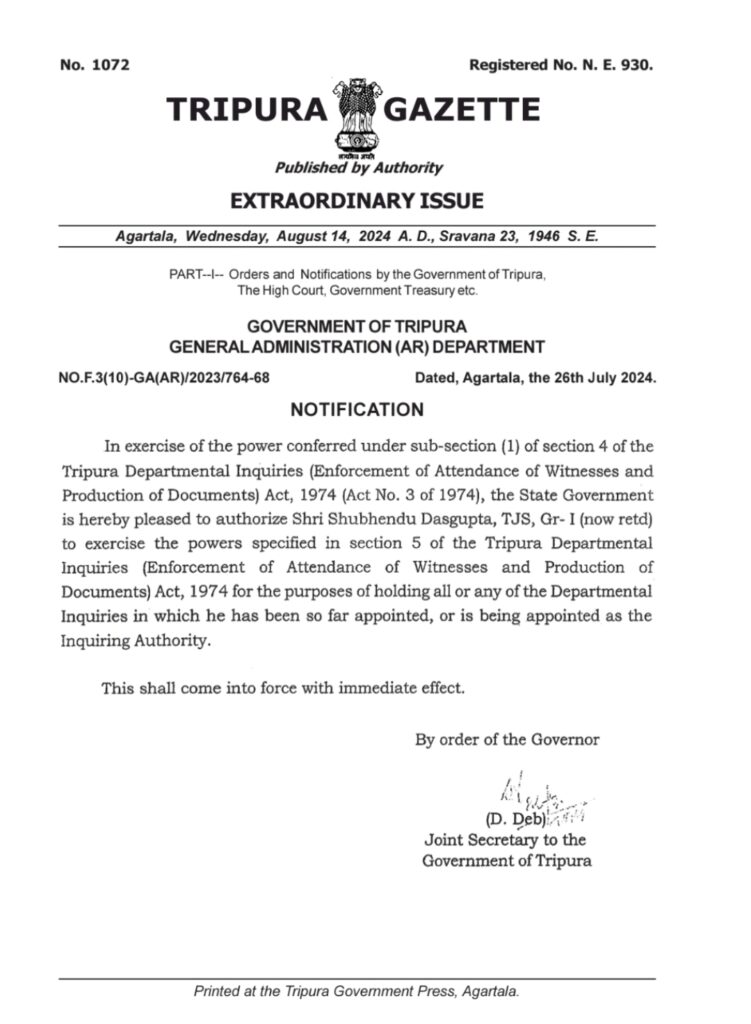
Inside the corridors of Tripura’s administration, one question is echoing louder than ever—is this governance as per rules, or is there a well-planned, invisible power play unfolding behind the scenes? When recent documents, administrative inputs, and a series of developments are examined together, the emerging picture is not isolated. Rather, it points toward a consistent pattern that puts administrative transparency under serious scrutiny.
At the center of this controversy is Debjani Deb (TCS, 2007 Batch). As per the Gazette Notification dated July 26, 2024, retired officer Subhendu Dassgupta was appointed as the Inquiring Authority for a departmental proceeding, with the document signed by Debjani Deb in her capacity as Joint Secretary of the GA (AR) Department. This raises a fundamental question: when the authority to appoint an Inquiry Officer generally lies with the GA (P&T) Department, how did a Joint Secretary from GA (AR) exercise such power? Was she the competent authority, or were established rules bypassed?

The matter becomes even more serious as the inquiry is being conducted under Rule 14 of the CCS (CCA) Rules, 1965, which mandates strict adherence to prescribed procedures and timelines. Were these procedures followed in their entirety, or were there deliberate deviations? This question is now being actively debated within administrative circles.
The controversy deepens further with reference to an allegation dated October 9, 2023. It is claimed that the then DM & Collector, Dr. Vishal Kumar, had filed an FIR against Debjani Deb in connection with alleged land-related irregularities in Bishalgarh, reportedly linked to a land scam. Additionally, sources within the administration suggest that multiple observations against her exist in records maintained by her controlling officer as well as the Accountant General (Audit). There are also strong indications that a Public Interest Litigation (PIL) is being prepared and may soon be filed in court.
This raises a critical concern—how is an अधिकारी with such serious allegations still entrusted with key administrative responsibilities? Is this merely an administrative decision, or is there a larger underlying interest at play?
Adding to the controversy are claims from within administrative circles that Anindya Kumar Bhattacharya is reportedly dependent on Debjani Deb in multiple proceedings, often requiring her presence during hearings. This has triggered another pressing question—why is the Vigilance Department silent? Why this apparent state of inaction?
A phrase now doing the rounds within administrative circles sums up the concern: “The system itself is compromised from within.”
If the very department entrusted with ensuring transparency and accountability becomes questionable, where does impartiality stand?

Another key figure in this unfolding scenario is Subhendu Dassgupta. Despite being a retired official, why is he repeatedly entrusted with sensitive investigations? Notably, on April 3, 2023, he had already been empaneled as an arbitrator under the Arbitration and Conciliation Act, 1996, making him part of a quasi-judicial framework. In such a situation, does his repeated appointment as an Inquiry Authority raise concerns of conflict of role and violation of the principles of natural justice?
The picture becomes even more striking with the inclusion of a third name—A.K. Bhattacharjee.
According to sections within the administrative community, Debjani Deb, Subhendu Dassgupta, and A.K. Bhattacharjee together form a tightly-knit circle of influence, where decision-making, investigation, and outcomes appear to revolve within a confined loop.
This raises a serious question—are sensitive cases being deliberately assigned to specific individuals? Is this merely coincidental, or does it indicate a calculated “pattern of allocation”?
The most explosive question, however, remains—does this entire process involve underlying financial interests or institutional advantages? While independent verification of these claims is still pending, the repeated appearance of the same names and patterns makes it increasingly difficult to dismiss these concerns.
Taken together, this is no longer just about a single inquiry. It has evolved into a larger question of transparency, neutrality, and ethical governance within the administrative framework.
At this stage, another sensitive issue arises—whether an unseen nexus of financial or institutional interests is influencing these processes. Though such claims have not yet been independently verified, the recurring patterns within the system make them hard to ignore.
In conclusion, this is not merely an isolated administrative issue. It raises fundamental concerns about transparency, neutrality, and institutional balance within governance. The answers remain unresolved.
But the whispers in the corridors are now turning into a roar—
Is this governance, or is there an invisible administration operating behind the visible one?
Questions are also being raised within the Secretariat about how much of this matter is known to the Chief Minister, Dr. Manik Saha. Some suggest that no action has been taken so far because the relevant files may not have reached his attention.