
“Where Did the ₹10 Crore IFMS Fund Go? Allegations of Financial Mismanagement, Audit Suppression, and Constitutional Violations Rock Tripura Finance Department”
Duranta TV Correspondent | Agartala
A major controversy has erupted in Tripura over serious allegations of financial irregularities, administrative misconduct, and suppression of audit findings within the State Finance Department. At the center of the allegations is Akinchan Sarkar, Additional Secretary of the Finance Department, who has been accused of deliberately failing to implement the Integrated Financial Management System (IFMS) funded under the 12th Finance Commission, thereby enabling systemic financial leakages and alleged corruption running into crores of rupees.
The controversy has intensified further following allegations that a crucial audit report prepared by the Comptroller and Auditor General (CAG) of India was allegedly withheld from being placed before the State Legislature for more than two years, despite constitutional provisions mandating such submission.

The ₹10 Crore IFMS Project: Objective vs Reality
Under the recommendations of the 12th Finance Commission (2005–2010), the Government of Tripura reportedly received ₹10 crore for implementing an Integrated Financial Management System (IFMS). The purpose of the project was to digitally integrate all major financial operations of the State Government — including Budget, Treasury, Payroll, Pension, GPF, and Accounts — into a single unified platform.
The intended objective of the IFMS was to establish:
- Real-time financial monitoring
- Automated validation systems
- Elimination of duplicate payments
- Transparent treasury operations
- Zero leakage in government expenditure
- Seamless data integration across departments
However, allegations suggest that the original IFMS model was never fully implemented. Instead, the project was allegedly fragmented into two separate software systems developed by two different agencies.
According to the allegations:
- CTOS (Treasury Software) was developed by RITES Ltd.
- HRMS (Human Resource Management System) was developed by Tata Consultancy Services (TCS).
Experts familiar with government digital systems claim that the coding architecture and database structures of these two systems were fundamentally different, making seamless integration nearly impossible from the very beginning.
As a result, instead of automated synchronization, departments allegedly continued depending on manual data entry for salary processing, employee validation, pension records, and treasury reconciliation.
Critics argue that this manual intervention created a fertile ground for financial irregularities, duplicate payments, fake salary disbursements, and unauthorized transactions.
Alleged Warning Ignored: Transfer of Former Under Secretary
The issue reportedly became more serious after a former Under Secretary of the Finance Department, Atanu Dewanji, allegedly raised concerns through an official file note during 2019–20.
According to sources, Dewanji warned that unless HRMS and CTOS were properly integrated, large-scale financial fraud could occur in the future and responsibility would fall upon the senior officers of the Finance Department.

However, allegations claim that within a month of raising these concerns, Dewanji was transferred out of the Finance Department to the Co-operation Department.
Many observers are now describing the incident as a possible case of “whistleblower suppression,” alleging that an officer who highlighted systemic vulnerabilities was removed instead of corrective action being taken.
CAG Audit Exposes Massive Financial Irregularities
A major breakthrough came when the Office of the Accountant General (A&E), Tripura, on behalf of the Comptroller and Auditor General (CAG) of India, conducted an IT Audit between June 1 and December 31, 2023.
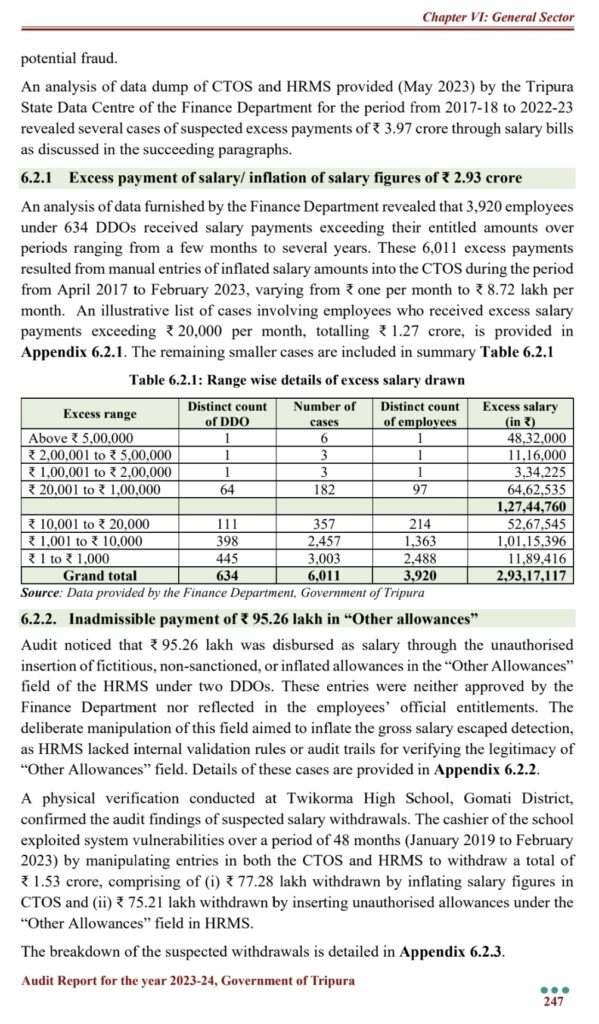
The audit reportedly uncovered widespread financial irregularities linked to the non-integration of HRMS and CTOS systems.
Among the major findings allegedly identified in the audit were:
- Misappropriation of approximately ₹1.52 crore under “Other Allowance” by a cashier between 2017 and 2023;
- Overpayment of salaries in 6,249 cases involving 659 Drawing and Disbursing Officers (DDOs), amounting to more than ₹2.24 crore;
- Salary mismatches between HRMS and CTOS records;
- Salaries credited to wrong bank accounts;
- Payments made to retired and terminated employees;
- Double payments of GPF, gratuity, leave salary, and pension-related benefits;
- Duplicate salary disbursements within the same month;
- Irregular festival advance payments and suspension-period arrears.
The audit reportedly estimated confirmed financial irregularities worth over ₹9.15 crore.

Significantly, the CAG audit itself reportedly stated that only around 50 percent of the bills were test-checked. Observers argue that a full-scale audit could potentially reveal financial losses far exceeding the currently identified amount.
Allegations of Constitutional Violations
The controversy has taken a constitutional dimension due to allegations that the audit report was not placed before the State Legislature as mandated under Article 151(2) of the Constitution of India.
Under constitutional procedure, CAG reports relating to State finances must be submitted to the Governor and subsequently laid before the Legislative Assembly.
According to the allegations, although the draft audit report was reportedly submitted to the Finance Department in January 2024, it has still not been tabled before the Assembly as of May 2026.
Critics claim that withholding the report prevented the Public Accounts Committee (PAC), legislators, and the public from learning about the alleged financial irregularities.
Legal experts suggest that if proven true, such actions could amount to serious violations involving constitutional accountability, administrative transparency, and financial governance norms.

Demand for Investigation and Action
Following these allegations, several demands have reportedly emerged from various quarters, including:
- Immediate suspension or removal of the concerned official;
- A CBI investigation into the utilization of the ₹10 crore IFMS fund;
- Examination of files, assets, bank accounts, and alleged benami properties linked to the officials concerned;
- A Special Audit of the Utilization Certificate related to the 12th Finance Commission grant;
- Immediate tabling of the CAG Audit Report before the State Legislature;
- Protection for former Under Secretary Atanu Dewanji under the Whistle Blowers Protection Act;
- Development of a new integrated IFMS in compliance with modern financial governance standards.
Political and Administrative Questions Intensify
The controversy has triggered intense debate within political and administrative circles in Tripura.
Questions are now being raised regarding whether the alleged failures were merely administrative lapses or part of a deeper systemic breakdown in financial governance.
Political observers note that the issue has become a major test for the State Government’s repeated commitment toward “Zero Tolerance Against Corruption.”
If the allegations are eventually substantiated through an independent investigation, the matter may not remain confined to financial irregularities alone but could evolve into one of the most serious administrative accountability controversies in recent years in Tripura.
