
Agartala Correspondent, Duranta TV :
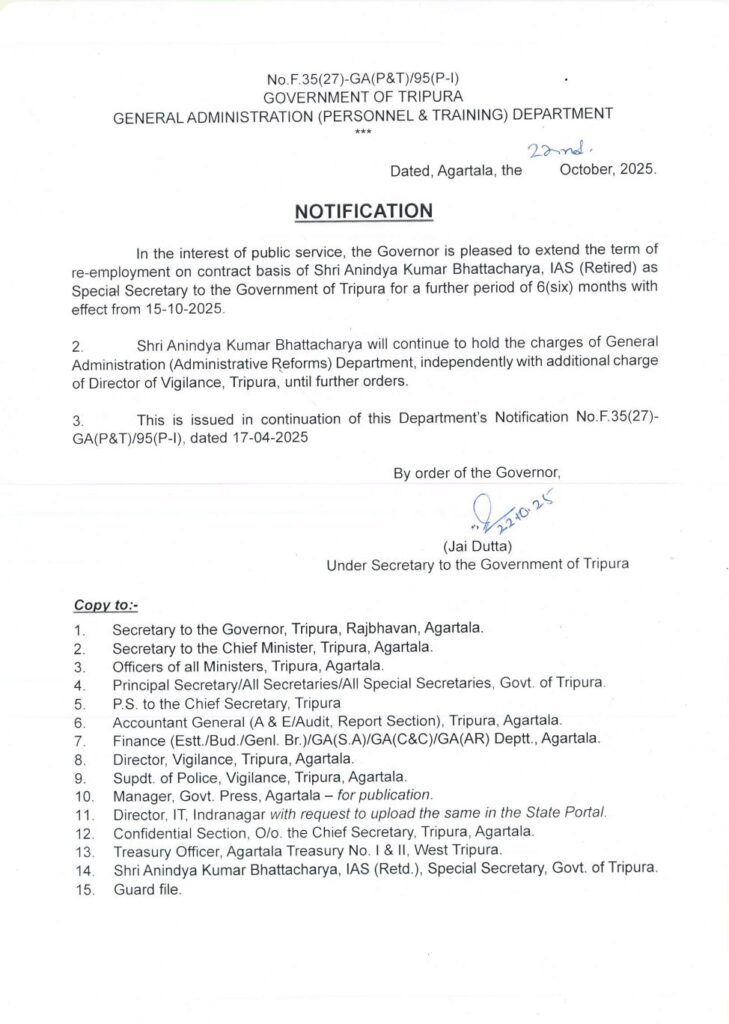
A fresh controversy has emerged over a government order issued by the state administration. Allegations have surfaced that the official order dated October 22, 2025, concerning the sixth reappointment of retired IAS officer Anindya Kumar Bhattacharya contains two contradictory provisions. The matter has sparked discussions and raised questions among administrative circles as well as the general public.
The first paragraph of the government order clearly states that the reappointment of Anindya Kumar Bhattacharya would take effect from October 15, 2025, and remain valid for a period of six months. In other words, the tenure of the reappointment was specifically defined and time-bound.
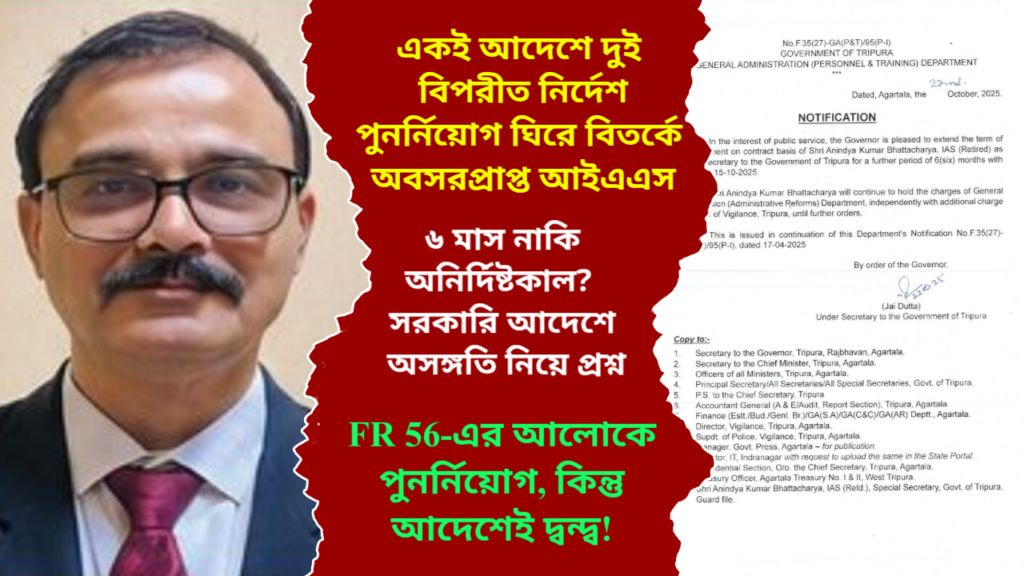
However, the second paragraph of the same order states that he would continue to serve in the General Administration (AR) Department and additionally hold the charge of Director, Vigilance, until further orders are issued. This has led to obvious questions: if the reappointment was sanctioned for only six months, on what legal or administrative basis was he allowed to continue in office “until further orders”?
According to a section of administrative observers, the inclusion of two different timelines within the same order creates serious ambiguity and raises concerns regarding administrative transparency and decision-making. While one provision prescribes a fixed tenure, the other appears to imply an indefinite continuation in office. As a result, questions have been raised about the interpretation and validity of the order.
It is worth noting that under Fundamental Rule (FR) 56, matters relating to retirement and post-retirement reemployment of government officials are generally governed by specific conditions and administrative requirements. Reappointments are ordinarily made for a clearly defined period and for reasons of public interest or administrative necessity. Experts believe that transparency demands that the tenure, responsibilities, and terms of such appointments be stated unambiguously.
This has led to further questions. Were the state’s top administrative authorities aware of the contradictory language contained in the order? Did the office of the Chief Secretary thoroughly examine the document before it was issued? Or has such inconsistency become an accepted feature of governance at the highest administrative levels?
At a time when the state government frequently emphasizes good governance and administrative transparency, the existence of seemingly conflicting provisions in the same official order has inevitably generated public concern. So far, no formal clarification has been issued by the government or the concerned department regarding the apparent inconsistency.
It now remains to be seen whether the government will provide an official explanation for the controversial order or whether the questions surrounding it will remain unanswered.